
The flavors of Vietnam: tracing memories and traditions
By Adriana Abril, Emilie Belet, Inès De Greef, Giulia Fracassi, Ali Hamdan, Claudia Scharff
Introduction
In Vietnamese, saying “cơm muối” or “rice and salt” is like saying “bless you”, a phrase rich in cultural meaning. During the 2024 Living Lab experience in Hoa Binh Province, Northern Vietnam, students and professors from Belgium and Vietnam embraced this spirit, exploring the region’s culture and community ties through the lens of food.
Surrounded by mountains and rice paddies, our group stayed with local communities across three villages, immersing ourselves in the food traditions of ethnic minority groups like the White Thai, Muong, and Dao Tien. Alongside professors and students from the KU Leuven and Vietnam National University (VNU), we discovered how deeply food connects people to their history, environment, and local traditions. Every meal and conversation revealed more than flavors; they shared stories, customs, and connections.
Trying the Flavors of the Hoa Binh Province
In September 2024, we experienced our Living Lab project in Northern Vietnam, surrounded by green mountains and rice fields. This beautiful setting introduced us to the rich cultural and culinary traditions of the area. We stayed in three locations in Hòa Bình Province— Mai Hịch, Sung Village, and Da Bia—where we spoke with local communities from different ethnic minority groups: the White Thai, Muong, and Dao Tien.
Students and professors from the KU Leuven and VNU explored a range of topics, from biodiversity and water quality to social issues like our group’s focus on food traditions. We concentrated on the food customs of Vietnam’s ethnic minorities, uncovering the area’s social dimension, composed of stories, relations, memories that linked the vibrant green landscapes to Vietnam’s rich cultural diversity, and much more.
Food served as an ideal gateway to delve into broader topics like community relationships, traditional ecological knowledge, and the spiritual significance of certain dishes. Through food, we examined both tangible aspects—such as ingredients and cooking techniques—and intangible elements, like cultural meanings and the symbolic roles these dishes play in local customs.
A bamboo flow: the lens of food traditions
To explore Vietnam through the lens of food, we conducted participatory observations, five focus groups and interviews with seven community members, including leaders, cooks, and guesthouse owners. This qualitative approach provided insights into the perceptions, experiences and opinions of different ethnic minorities. Discussing food offered an intimate perspective on social life in rural communities, deeply intertwined with the natural environment that supplies their ingredients.
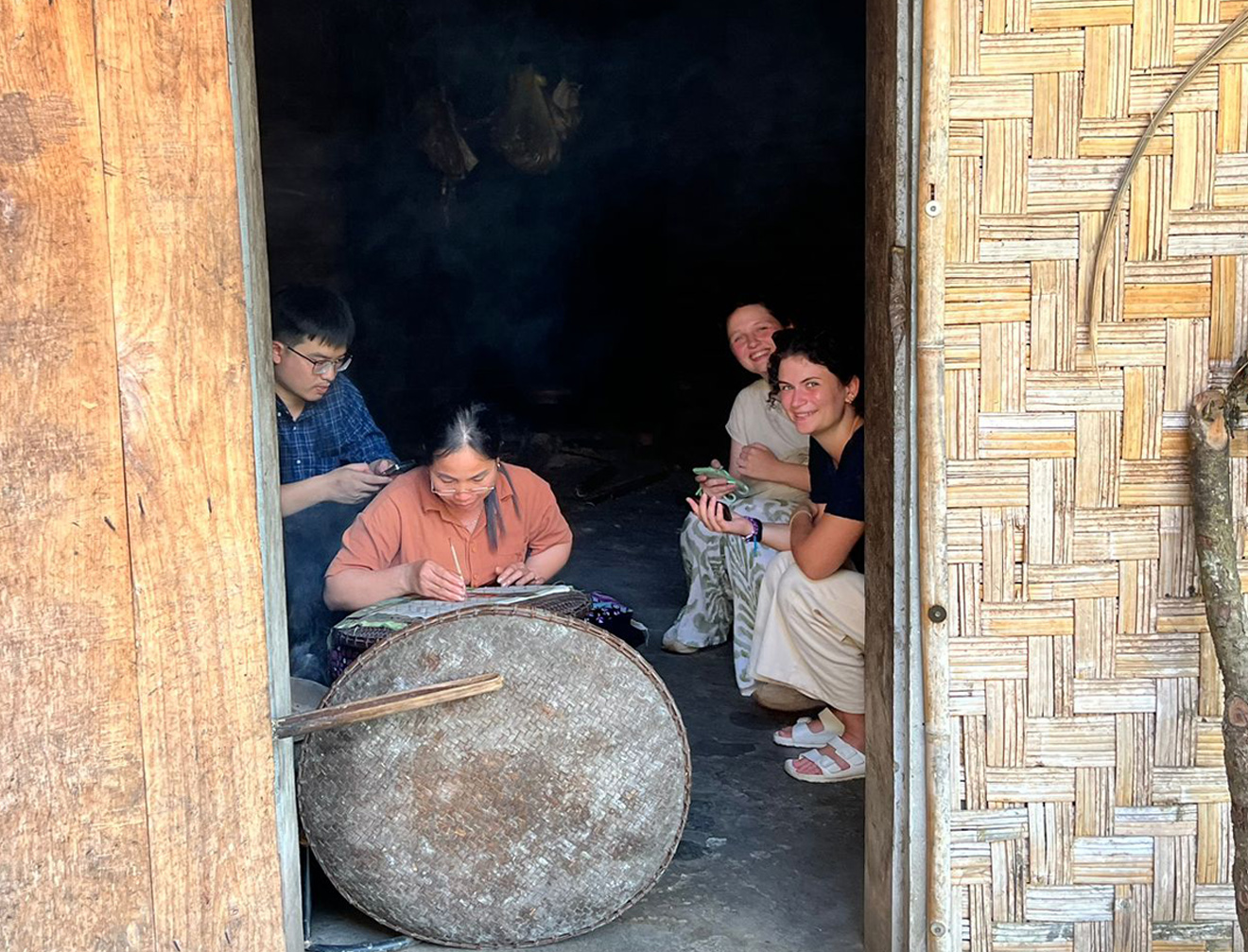
Interview in Sung Village to a guest house owner. © Creative Commons
The focus groups began with participants looking at pictures of traditional local dishes. They introduced themselves by sharing the stories and meanings behind their chosen dish. This helped build pride and created a comfortable space for discussing food supplies, community ties, and future hopes. The image below shows the participants sitting in a circle with the dish pictures in the center.
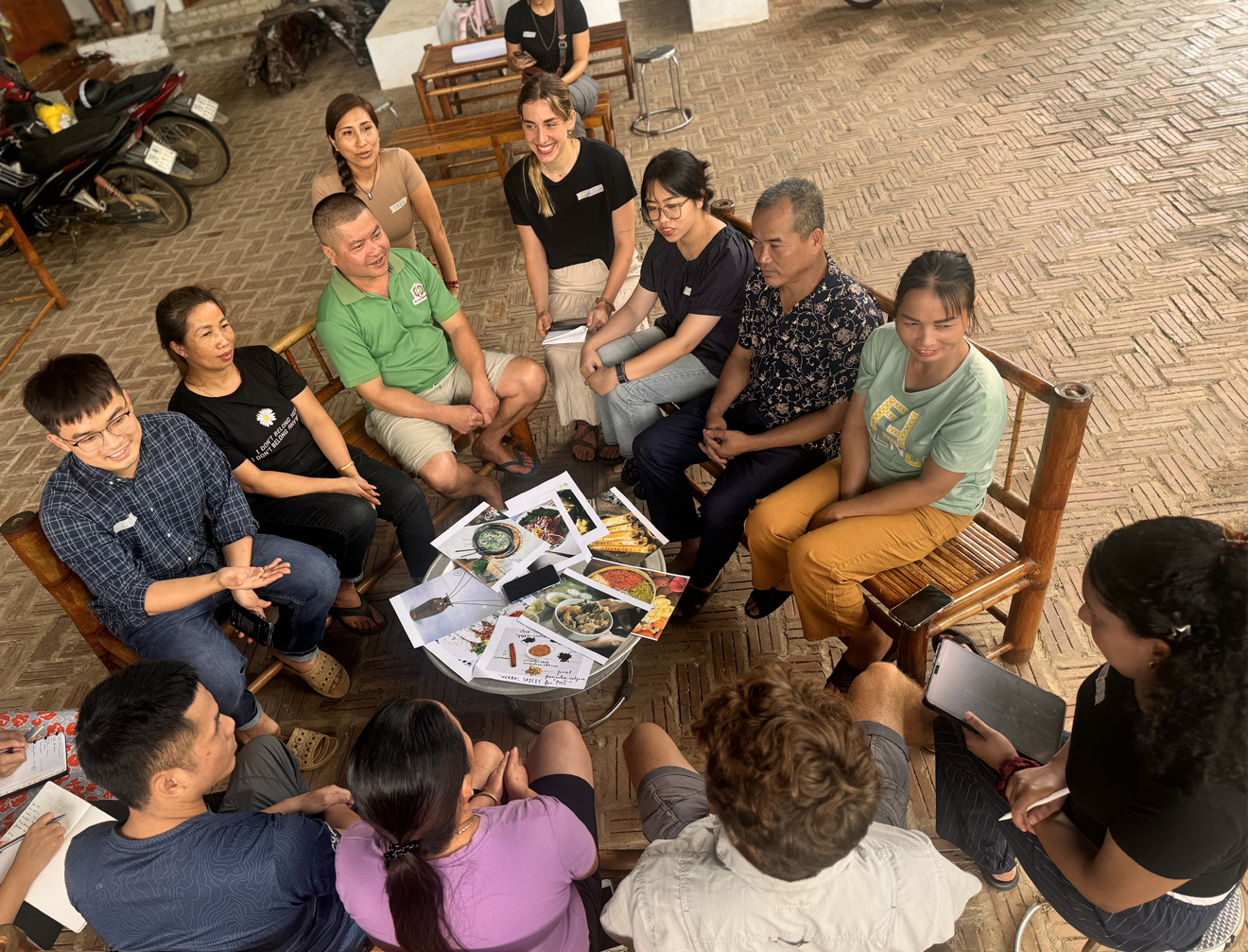
Focus group in Lac Village. © Creative Commons
Next, we separated the group into male and female participants for the main exercise, called the Bamboo Flow. This activity included discussions on food traditions, supply, and cooking methods, as well as community topics like gender roles, rituals, and education. Participants also reflected on institutional influences and shared their visions for the future of their traditions and communities. Sticky notes were used to track the topics discussed. The facilitator’s questions guided the conversation, starting with practical food matters and moving to broader topics like institutional relationships and future hopes.
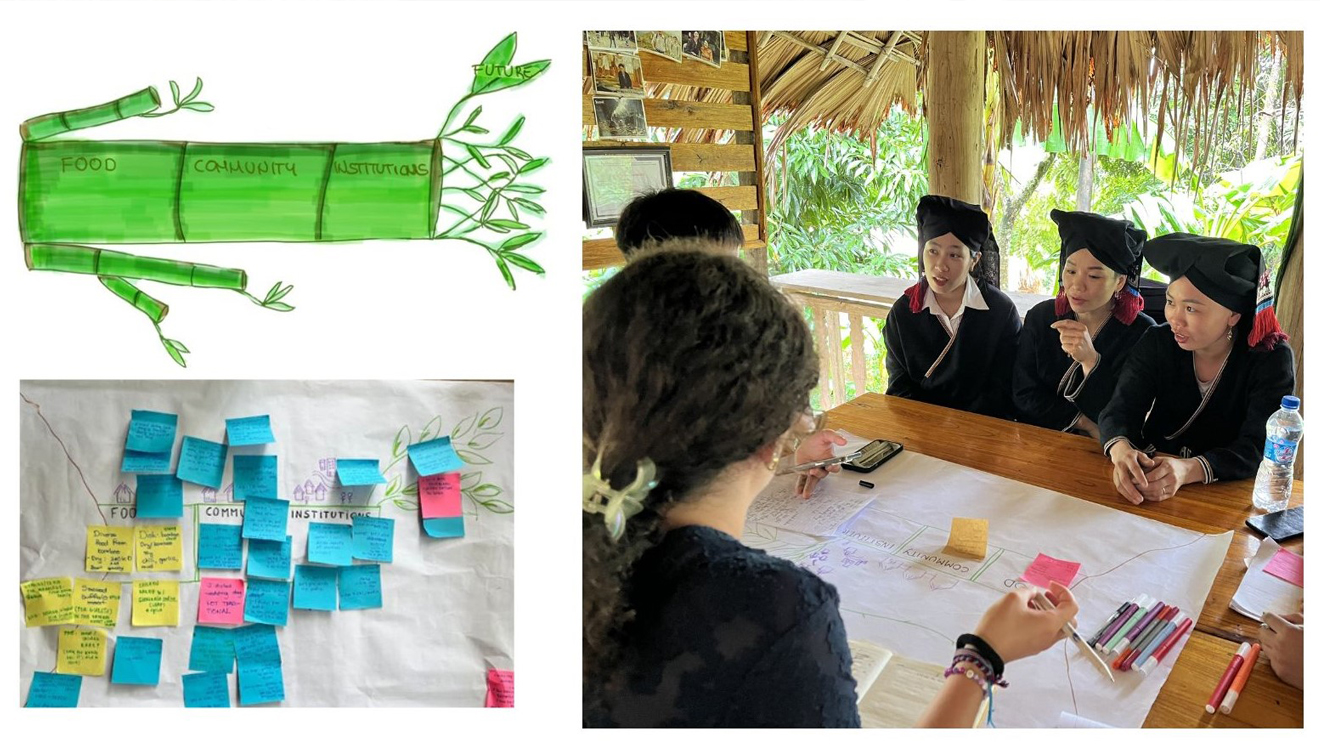
The Bamboo Flow exercise. © Creative Commons
The challenge of exploring food traditions inspired us to create interactive graphic tools that encouraged discussions of personal experiences and shared community aspirations. The results revealed key historical milestones, collective memories of food insecurity, traditional ecological knowledge, the impact of tourism, and hopes for the future of families and communities. The next paragraphs share some early findings from our research, giving readers a look into our Bamboo Flow process.
Vietnam’s Ethnic Landscape
Vietnam is home to 54 ethnic groups and a population of approximately 99 million.
The ethnic majority are the Kinh (86%) and the Hoa, who primarily reside in the inland deltas and coastal regions. In contrast, ethnic minority groups typically live in upland and
mountainous areas, including remote rural regions with limited access to healthcare and education.
Vietnam has significantly reduced poverty following decades of war and international isolation. In 1992, half of the population lived in extreme poverty, but by 2010, this was almost eliminated, with only about 20% still considered poor. Over the next decade, poverty rates continued to drop by half. However, some communities are still struggling, especially in remote and isolated areas where farming is less productive and there are fewer job options outside of agriculture. As we experienced in Sung Village, developments like roads, electricity, and internet access only arrived between 2003 and 2022.
“Ethnic minorities make up 15% of the total population but accounted for 79% of the poor in
2020. (UNDP, 2023)”
The biggest population of Muong (64%) lives in Hoa Binh Province, followed by Thai (4%) and Dao (2%) minorities. Each of these ethnic groups maintains distinct lifestyles, languages, and traditional dishes. Some like the Dao Tien are known for creating intricate clothing dyed with beeswax and indigo, while others, such as the Thai people in Lac Village, are actively involved in community-based tourism. Throughout our journey, we had the opportunity to appreciate this diversity that enriches the cultural landscape of Vietnam.
A Culinary Journey Through History
Vietnamese cuisine is deeply shaped by centuries of Chinese and French influence. In Rice and Baguette: A History of Food in Vietnam, author Vu Hong Lien explores the “hidden history behind the food”, revealing how these influences have left lasting marks on Vietnam’s culinary identity.
The Chinese ruled Việt people from 257 BCE until 938 CE, when they reclaimed independence, maintaining it until the French colonization began in 1859. French control ended in 1954, dividing Vietnam into the communist North, backed by China, and the American-supported South.
One of Vietnam’s most difficult historical events was the Great Famine of 1944-1945, during which at least one million people perished from starvation in the North. Natural disasters compounded by French colonial policies—such as prioritizing industrial cash crops over rice production—led to severe rice shortages and widespread famine.
From 1954 to 1975, South Vietnam was occupied by the United States. Following the war, the North imposed a centralized economy and rationing system across the country, resulting in food shortages and a deep economic crisis from 1975 to 1985. It was only in 1989, with economic reforms that embraced the private sector and international trade, Vietnam’s path began towards recovery and growth.
Vietnamese cuisine reflects this complex history. For example, rice noodles, introduced during the Chinese rule, became central to many traditional dishes. The French introduced dairy products like butter and cheese, as well as coffee, which remains a key export grown in the central highlands. The French colonial period also saw an increase in beef consumption, leading to the creation of phở, the iconic rice noodle and beef soup. Another legacy is the bánh mì, the Vietnamese baguette filled with local ingredients, now celebrated as a national dish. Overall this is a reflection of the country’s layered history, blending influences from centuries of Chinese and French presence with deep-rooted local traditions.
Traditional dishes in Hoa Binh
Cơm Lam: Vietnam’s Traditional Bamboo-Tube Rice
Northern Vietnam is thought to be one of the first regions where rice was domesticated, making it a cornerstone of Vietnamese cuisine. Long before clay pots, tubes of bamboo were used to cook and store food, a tradition still alive today. In Northern Vietnam, fresh bamboo tubes are used to cook rice, meat, and vegetables over an open flame, infusing each ingredient with a delicate aroma. During our interviews, Cơm Lam (bamboo rice) emerged as a favorite dish among Thai and Dao Tien communities. A woman from the Na Phon commune shared her memories:
“… this dish reminds me of my childhood. It has been a part of my life since I was young, as my parents and grandparents used to make it. Partly because life was difficult back then, when working in the fields without a container for food, Cơm Lam was used to carry and preserve rice.”
To make cơm lam (bamboo rice), line a young bamboo tube with banana leaves, add soaked sticky rice and water, then seal with more banana leaves. Roast over a fire, rotating to cook evenly. As a Dao Tien man from Sung described, “When eating, we peel it off to enjoy—it has both the delicious taste of rice and the fragrant taste of bamboo”. This traditional cooking method continues to connect past and present, infusing each bite with history and flavor.
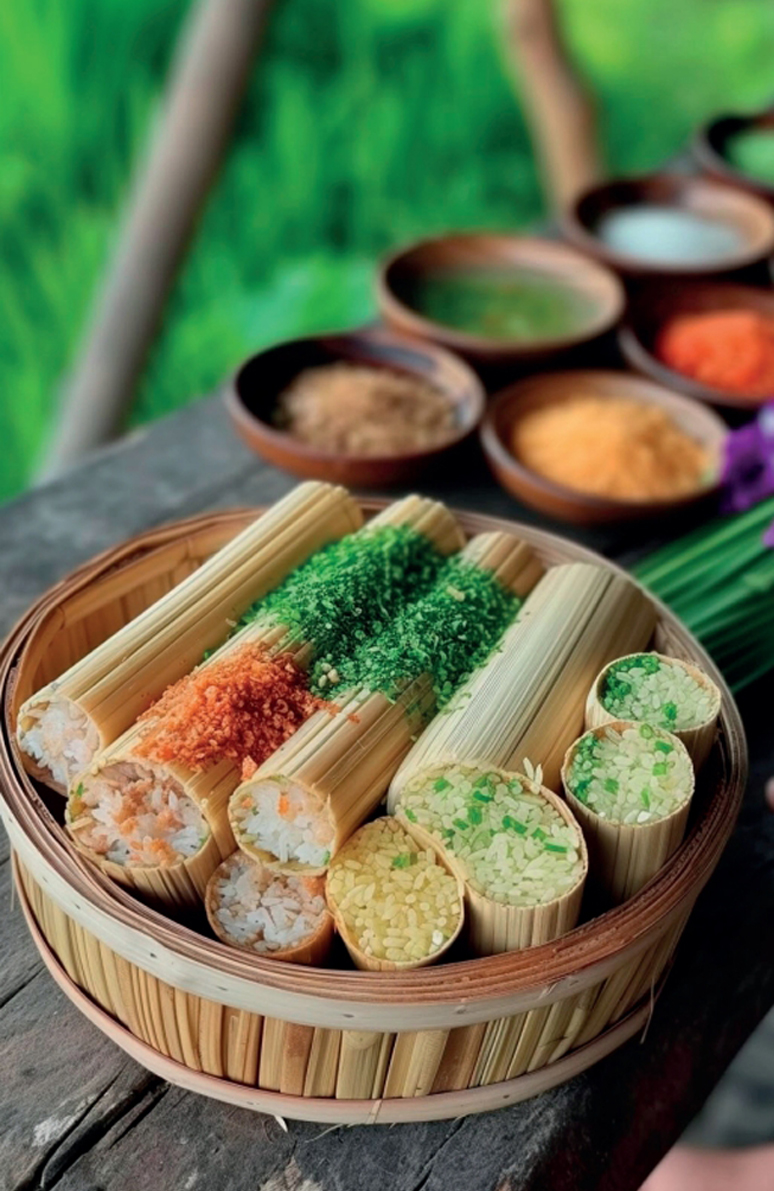
Bamboo Tube Rice. Author: Pham Cao Phuong, Hoang Van Huan, and Claudio Longo Bifano. Supported by IFAD, 2024. © Creative Commons Attribution
Five color sticky rice: Xôi ngũ sắc
During our interviews, we discovered another beloved dish: five color sticky rice. This vibrant delicacy is crafted using leaves from plants identified by local communities: “some plants have larger leaves and thicker leaf blades.”
One local explained, “I dye the rice with lá nếp cẩm (black glutinous rice leaves). I first boil water with the leaves, let it cool, and then soak the rice in the dyed water to achieve these beautiful colors.” This dish is served during special festivities.
The rice harvesting process spans over five months, culminating in late September and early October according to the lunar calendar. The golden hues of the rice paddies during this time signal the celebration of the New Rice Festival in the Thai communities of Mai Chau.
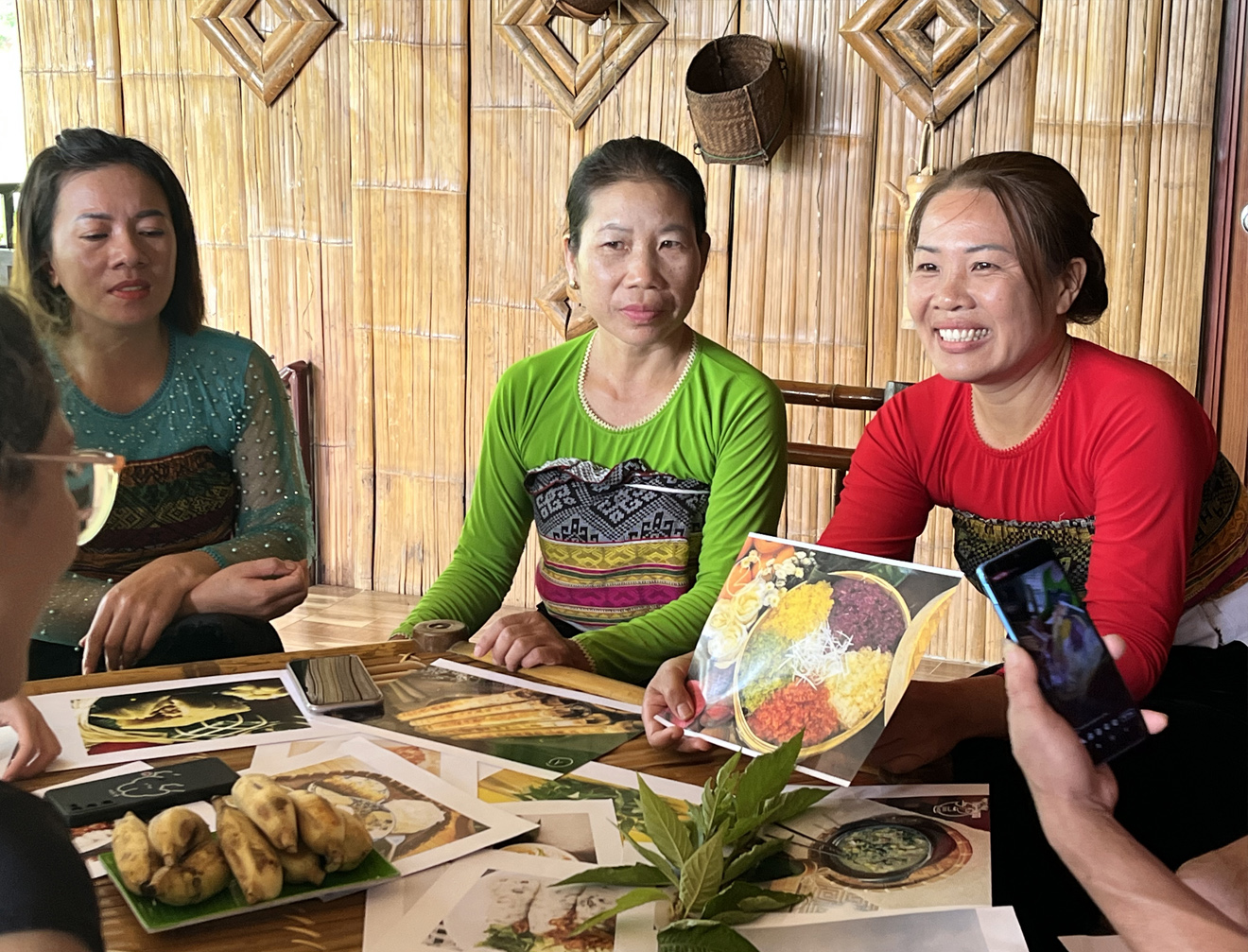
A Thai woman shows the five color sticky rice dish in a group interview. Author: Vera Flores © Creative Commons
Dried Buffalo Meat and Rice Wine: Thịt Trâu Gác Bếp and Rượu Cần
In Vietnam, water buffalo symbolize the country’s agricultural life, serving as plow animals and a source of meat. Dried buffalo meat is a prized delicacy, especially valued for its fragrant, smoky flavor, and it’s typically reserved for special occasions like Tet celebrations. At around 220,000 VND per kilogram, this meat is a luxury that families save for holidays or honored guests. In Thai communities, buffalo meat is traditionally served in stilt houses, often placed in front of the ancestors’ altar on pots or dong leaves, and enjoyed with rice wine.
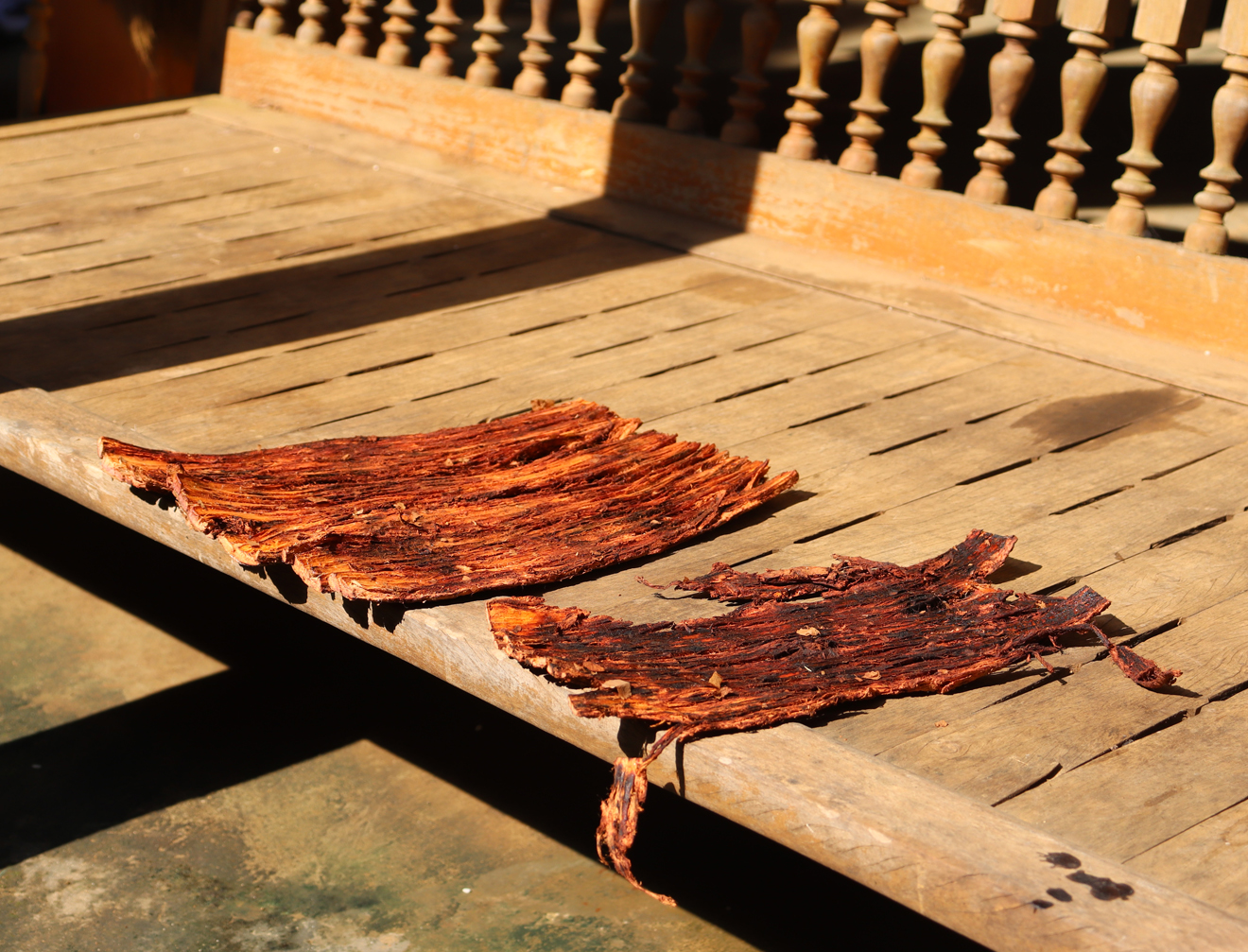
Sun-dried buffalo meat in the stilt house of a Thai community in Vietnam. Author: Adriana Abril © Creative Commons
This rice wine, known as rượu cần, is made from glutinous sticky rice—a tradition dating back to the Hồng Bàng dynasty in ancient Vietnam. In the highlands, people continue to make rượu cần by cooking sticky rice, drying it in the sun, then mixing it with a fermentation agent made from tree bark and spices. The mixture is sealed in earthenware jars with dried banana leaves and left to ferment for a month. A Thai villager explained, “To make rượu cần, it needs to ferment for 20–25 days to develop its flavor. For the Thai people, rượu cần is reserved for important occasions like weddings or funerals. It’s a very meaningful drink to us”.
After our first group interview, we were invited to share rice wine and taste traditional dried buffalo meat. In the picture below, you can see the buffalo meat at the center, torn into long, flavorful strips and served with a spicy red dipping sauce. Alongside, small cups of rice wine adding to the experience.
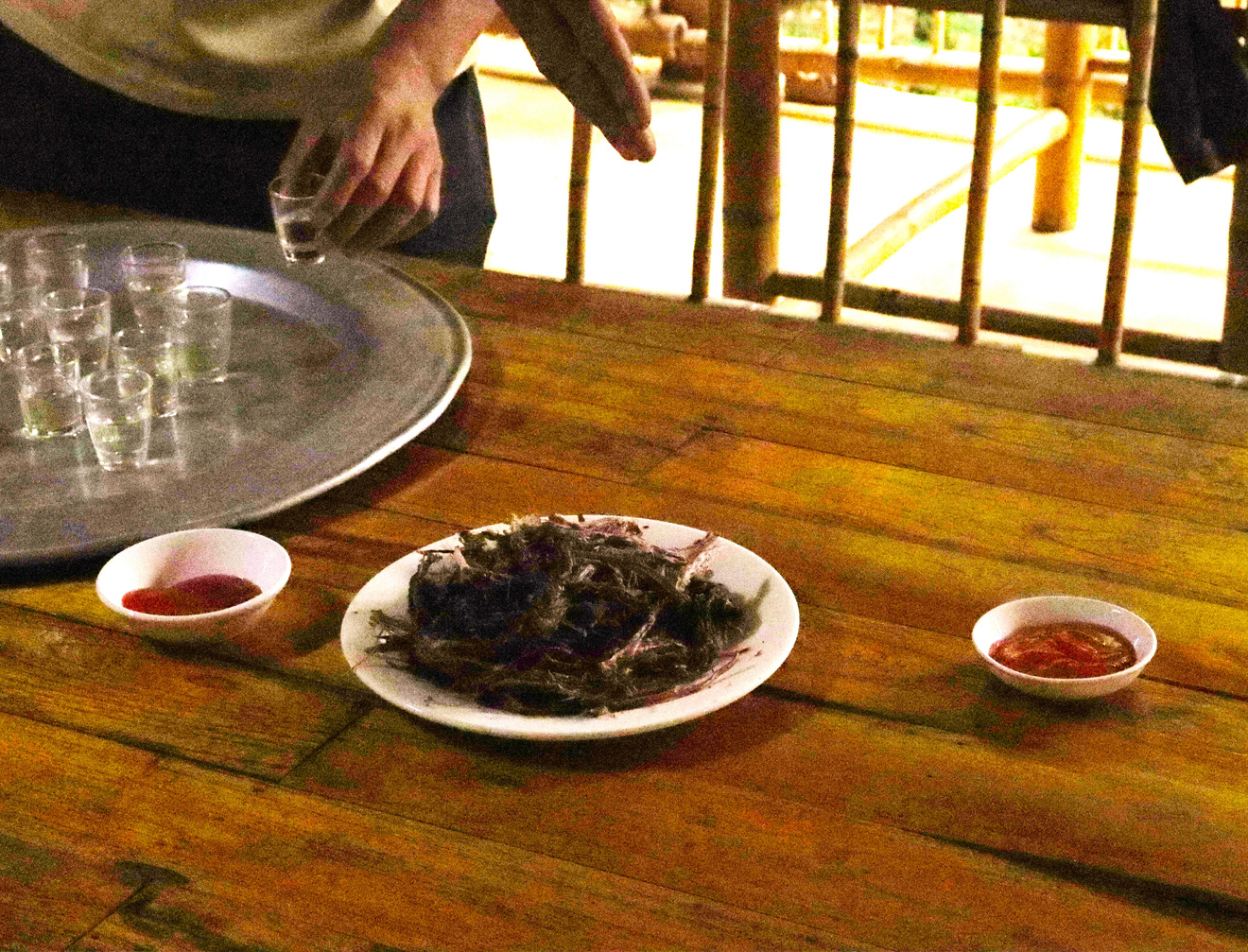
Dried buffalo meat and cups with wine rice. Author: Inés De Greef © Creative Commons
Summing Up Our Experience
As our journey in the Hoa Binh Province of Vietnam came to an end, we were left with a profound appreciation for the region’s rich culinary traditions and the stories that accompany them. Through the lens of food, we discovered how it serves not only as sustenance but also as a bridge between generations, cultures, and history.
The flavors we encountered—whether in the comforting bamboo rice or the smoky richness of dried buffalo meat—offered insights into the lives of the local communities. Our research extended beyond taste; it redirected us to the social dynamics, ecological knowledge, and spiritual beliefs that are intricately woven into the fabric of their culinary practices.