
Grow Eat Map
By Angel, Chloë, Margot, Matthias, Maxwell, Nurdita, Theo, Lucia
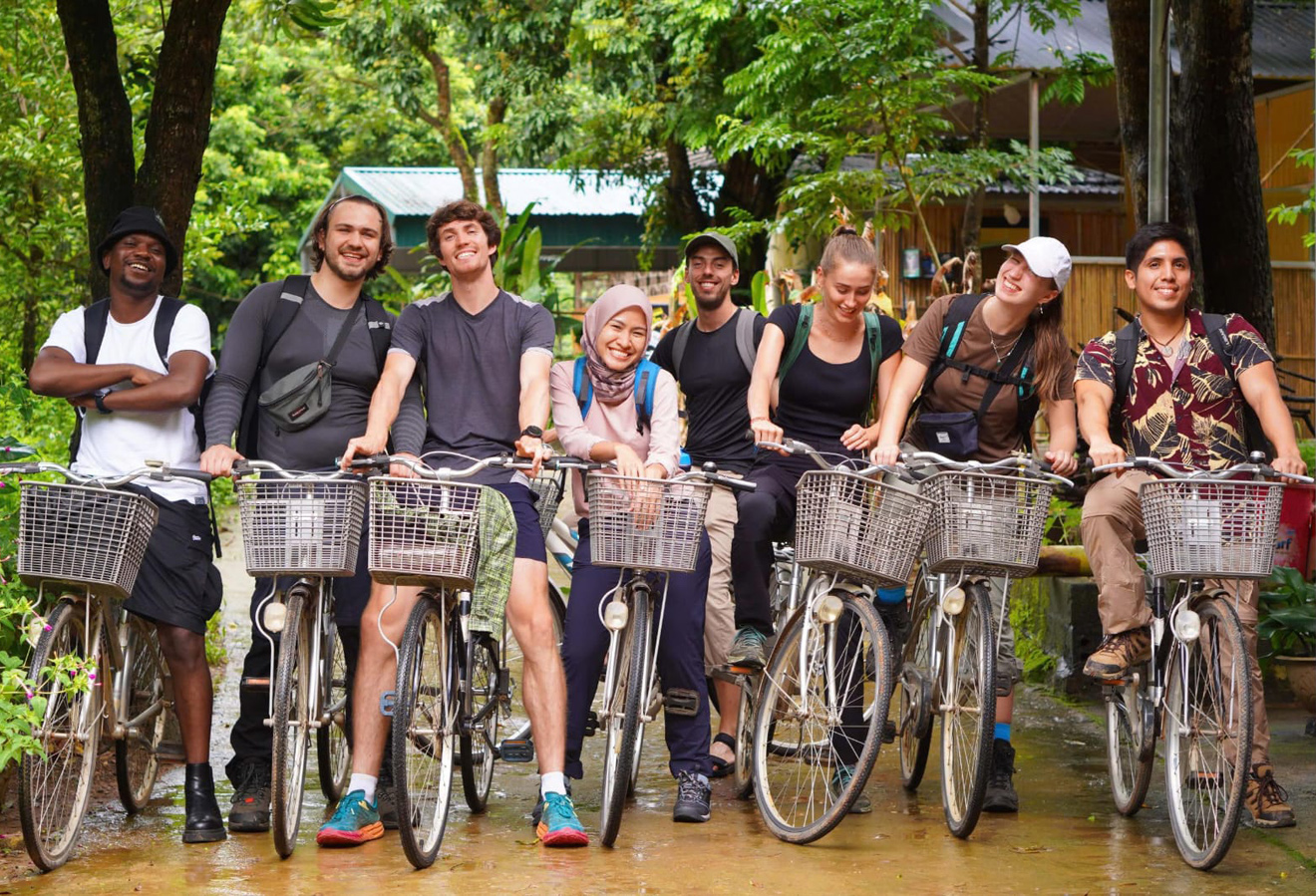
[On the left: HH Group at the start of the Living lab/ On the right: HH Group at the end of the Living lab, academic year 2023-2024 © SUSDEV
Preparing the journey
Everyone needs and loves food! As nutrition is a basic requirement in day to day life, delving into the intricacies of food consumption, and food supply chains, is a great way to approach the topic of sustainability. The resilience of a food system depends on all three pillars of sustainability: it is a function of the social, through tradition and social networks, of the economical, as it varies according to income and availability on markets, and of the ecological, as our food system depends on the environment it is grown in. Various shocks and stresses can afflict a food system, and the resilience of a food system refers to how resistant a particular food system is to stress. But how can we assess this ? One method is to map foodsheds. Foodsheds map where food consumed in a particular study area is coming from. This allows us to visualise supply flows, and allows us to identify characteristics that could affect the resilience of a food system in various scenarios.
If you’ve had the wonderful experience of wrestling with GIS programs, you most definitely had to use data sets of variables to map phenomena. Collecting data for this purpose was our main mission on this study trip.
Since late February our team worked to determine how best to do this. Through surveys, and geolocation, we naïvely expected to be able to collect a wide range of data, locate it, and all that would be left to do would be to transcribe it in Excel. Simple, right ?
Experience on arrival
Arriving in Vietnam was a rollercoaster of emotions to say the least. Typhoon Yagi hit Hanoi on our arrival confining us to our respective accommodations. You’d expect a team from Belgium to be used to rain, but Vietnam was on a whole different level. Once Yagi had passed over us, we joined up with the rest of the expedition team. We were welcomed with smiles, warmth, and good food by the local staff, and volunteers. We drove to the hills and narrowly avoided the floods in Hanoi. As the rain poured down the locals went about their lives greeting us with waves and smiles as our bus drove by. Along the way, the landscape shifted from urban areas to productive fields, and transitioning forests. The chaotic beauty of the Vietnamese countryside struck us on arrival. The bustling villages, contrasted with extreme weather showcased one of the main features of Vietnamese people that we were here to study: resilience.
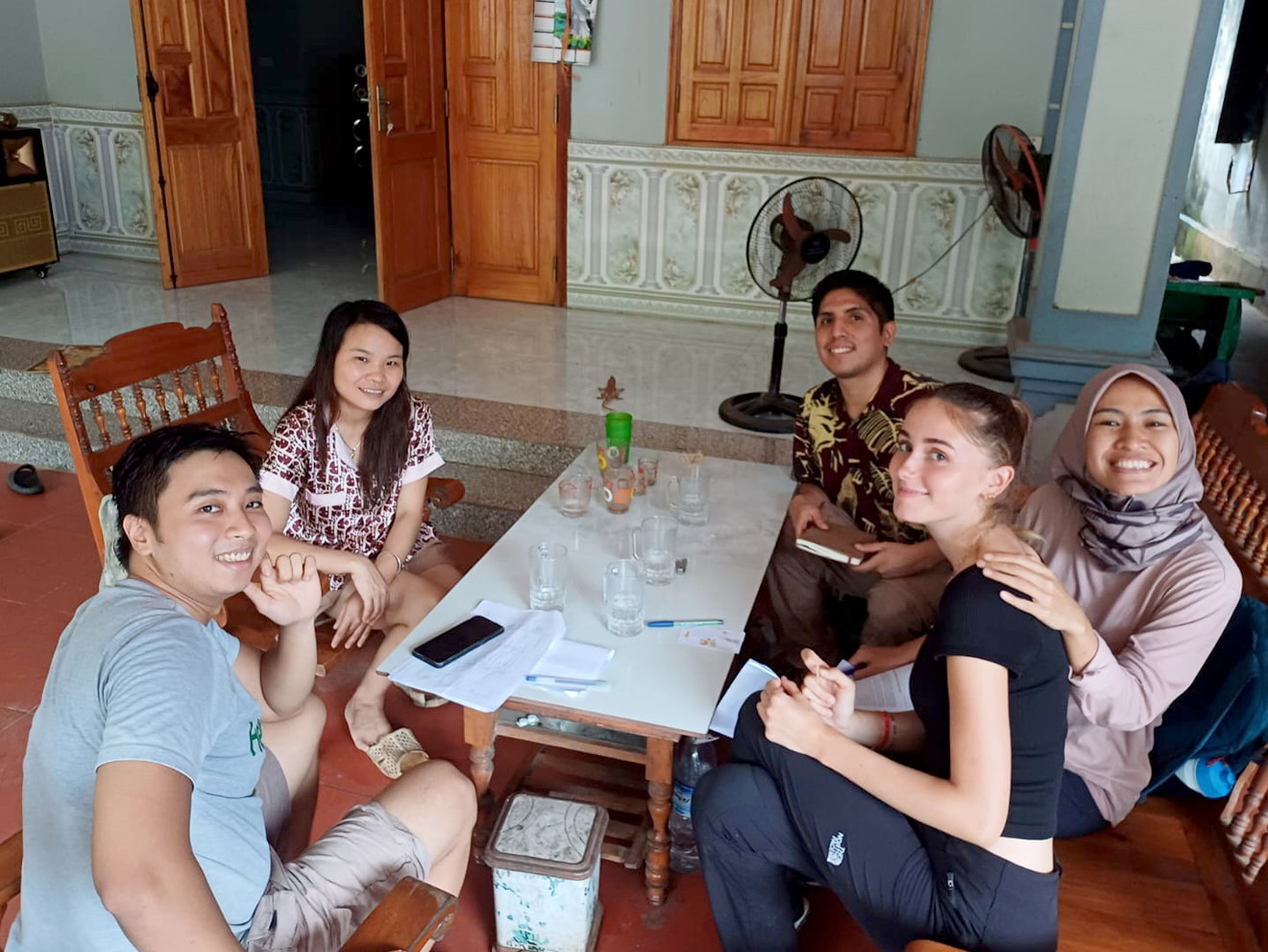
Picture after an interview on the first day, academic year 2023-2024 © SUSDEV
Describing ways of working: Experience from the field
As the expedition split up into research groups, with dedicated volunteers and translators, we explained our objectives, reviewed our surveys, practised and made changes thanks to the suggestions of our lovely Vietnamese team. Then off we cycled under the changing weather to conduct our first humbling interviews.
The interviews were an incredible experience with a steep improvement curve. To be allowed such intimate access into the lives of the local people was unique. We learned about peoples past, family and community lives, their struggles and achievements. We gathered so much information in fact, we realised that, with the limited time we had to collect data that would help us map and characterise the foodsheds of Hoa Binh, we had to make choices and restrict the scope of our surveys. On the other hand, one household after an other, we improved such that conducting the interviews became easier and faster. Therefore, although we significantly reduced the length of our interviews, we shared our experience in conducting interviews helping to reduce the interview time whilst maintaining our objective to collect as much information that could be relevant, and still allowing us to dive into specificities that might not be covered by our surveys. The experience in the field was invaluable in this sense.
When reading through various similar studies the difficulty to get to consistently quantifiable measures of food consumption our income is a challenge often underlined, but that we had overlooked before our experience in the field. Do you know the exact quantities of food types that you consume on a daily, weekly, monthly basis ? Perhaps, but if so, it is likely not to be in the same way as your neighbour. Whether in weight over a period of time, or quantities in a local unit that doesn’t easily convert to the metric system, we struggled at first to agree on how to ask for quantities of food types in such a way that would be relatable to as many households, so that data would easily quantifiable. This is one of the many such challenges we faced.
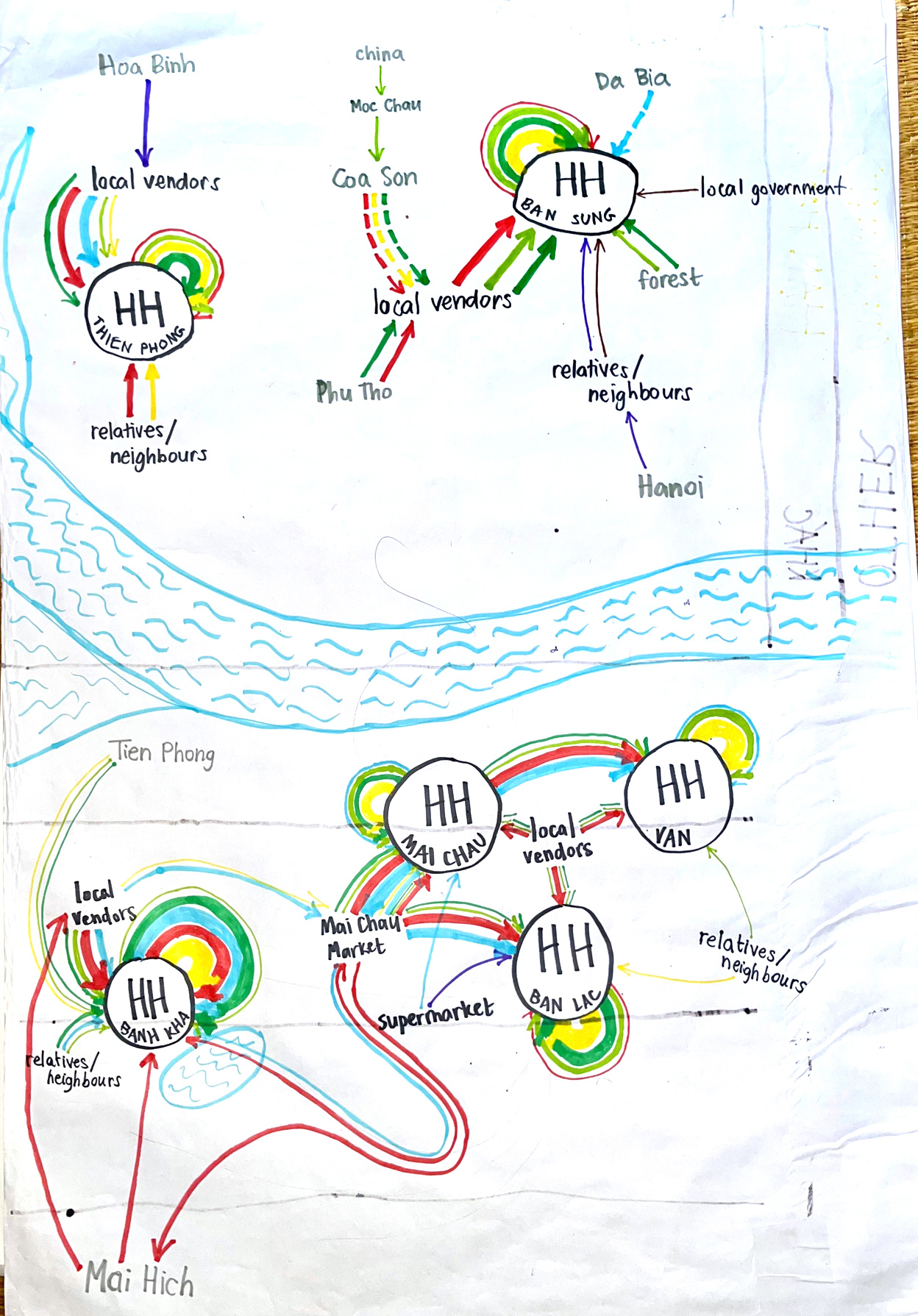
Preliminary schematic foodshed map, academic year 2023-2024 © SUSDEV
Final thoughts
The living lab experience was a privilege to be a part of, and provided invaluable experience into the intricacies of conducting a study abroad and the challenges that researchers face in collecting interpretable data. It highlighted the importance of international collaboration, field experience, and forces one to question familiar topics. For example, we expected supermarkets to be a main food source for locals, similarly to western Europe, whoever, many households produced a healthy contribution to their diet, or relied on the production of relatives, or sourced their food from street vendors, mobile vendors, or on markets. Many of our questions, or available answers to some of our questions, did not translate to the Vietnamese context. For example, in Da Bac commune, although many households had their own livestock, the slaughtering of livestock was done in relation to other households so as to guaranty a stable source of meat year round, meaning that often households relied both on self consumption and community networks for their food. Therefore, relying on community networks, did not correlate with food insecurity, outside of exceptional cases. Furthermore, when asking about imported products we only lately understood that respondents understood this as themselves importing food, and not whether they consumed products that came from abroad in general such sodas or snacks.
In future, closer collaboration with local partners before the study would greatly increase the efficiency of data collection, maximising the short amount of time available during the Field Lab, particularly when it comes to cultural specificities and how they might affect data collection.