
The art of starting from scratch –
How to learn resilience in sustainability research
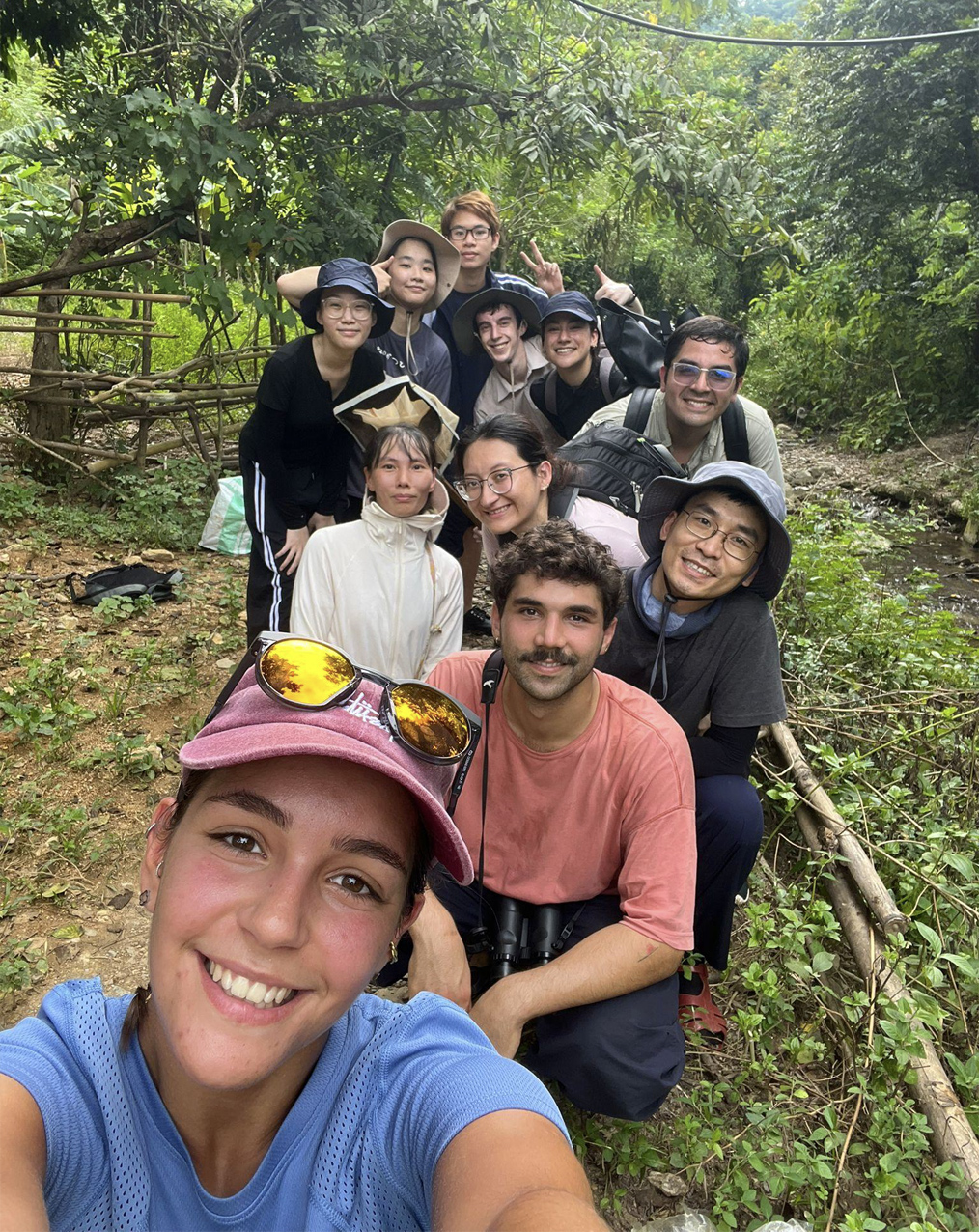
This is the Water Group 2025. Happy, lively and thriving after our first sampling day.
What this picture doesn’t show is that just a few hours before we learnt that our research question was unfeasible, and we had to start over with our research objectives. As you can imagine, those weren’t smiles of relief. Rather, it was us finally opening up to the unknown.
When plans meet reality
In the Living Lab preparation, as in several other aspects of our student life, there was a persistent sense of hope that if we planned carefully enough, we could control outcomes. We spent weeks elaborating what we thought was the perfect research question, designing our methodology, and coordinating with our supervisors, Kevin, professor Cuong and Hoa, so that they could prepare our equipment. We thought we had it all figured out.
But as it turned out, we didn’t.
The Five Stages of Academic Resilience (Or: How to Fail Forward)
1. Absorb the Shock
After our research question fiasco, there was a moment of collective silence. At that moment, we felt like our weeks of preparation lead to a dead end. The confusion hit us. However, despite the uncertainty, we realized that the first step wasn’t to fix everything. It was to feel everything. According to Nature Sustainability, Resilience includes the ability to absorb shocks, to persist and recover from disturbances: that was the moment to take the first step and absorb the shock.
2. Adapt the Approach
Resilience is not limited to absorbing shocks but also includes adapting to them, responding while maintaining intact the essential identity of a system. The second step was then to reflect and ask ourselves: What is our identity here? As a diverse group of students, we were able to merge our different perspectives and realized that even though our research question had to change, our identity did not have to. We finally recognized who we were: a group committed to learning from the environment and the people around us.
3. Transform the Perspective
This is where things got interesting. Resilience also includes the ability to transform with change, to create a fundamentally new system. Starting from scratch wasn’t going back to square one; it was an opportunity to think in different ways. We stopped asking “How do we salvage our original question?” and started asking “What can we learn from this place with the tools we have?”. We shifted our focus from objects to relationships, from outcomes to processes, and this opened up pathways we couldn’t foresee in our planning.
4. Navigate Emergence
That afternoon we did something we haven’t done before: we slowed down. Despite not having time. Despite having a presentation of our preliminary results the following day. And that was the best thing we could do: we spread out our field notes, our preliminary data, our half-formed ideas and simply talked. For hours. In a circular, repetitive way. And through that process, our new research question emerged. Complex systems have emergent behaviors and properties that are not the same as the sum of their parts. Our new research question didn’t come from any single person’s idea or from simply combining our backup plans. It emerged from our collective struggle, from conversations, from actually being present in the field rather than being committed to our assumptions. What emerged was something better than what we’d planned, more grounded, more alive, more interconnected to the reality we were studying.
5. Build Capacity Through
Challenge What matters is not just the resources that exist, but the dynamic capacity within the system to self-organize, maintain diversity, and co-evolve in relation to change. We didn’t just solve a problem; we built capacities for learning, for reflexivity, for navigating uncertainty together. We learned to question our assumptions before they led us down dead ends, to voice doubts without derailing progress, and to recognize when we were forcing a methodology onto a context that demanded something different.
The Resilience Paradox
Here’s the most surprising part: our debacle made us better researchers. Development outcomes and processes are emergent and dynamic, meaning that specific outcomes maynot be able to be developed in advance. We’d been conditioned to believe that good science meant controlling variables and predicting outcomes. But the best learning happened when we let go of that control.
A Choice at Every Crossroads
When unexpected challenges arise (and they will), you face a choice: evolve or calcify.
You can double down on your original plan. Or you can embrace what resilience science calls the ability to “live and develop with change—incremental and abrupt, expected and surprising” (Reyers et al., 2022).
This doesn’t mean abandoning standards or accepting mediocrity. It means recognizing that in complex adaptive systems, focusing too narrowly on parts of the system prevents innovative approaches able to account for the system’s dynamics.
Sometimes starting from scratch isn’t starting over, it’s starting better.
Your Turn
So here the invitation from the Water Group 2025: Let this be your sign to embrace change and growth. When your carefully laid plans meet reality, remember that you have a choice. You can rigidify, or you can absorb, adapt, and transform.
The art of starting from scratch isn’t about abandoning everything you’ve built. It’s about developing the capacity to self-organize, maintain diversity, and co-evolve in relation to change.
It’s about recognizing that sometimes, the path forward requires taking a step back, or sideways, or in a completely unexpected direction.
And most importantly, it’s about the people you navigate that uncertainty with. Because resilience, like research, is never really a solo endeavor.
Sources
Reyers, B., Moore, ML., Haider, L.J. et al. The contributions of resilience to reshaping sustainable development. Nat Sustain 5, 657–664 (2022). https://doi.org/10.1038/s41893-022-00889-6